
JO JO Lapa......Newar community welcomes you...
All information of the newar community
     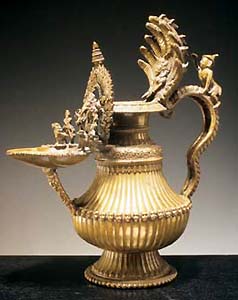 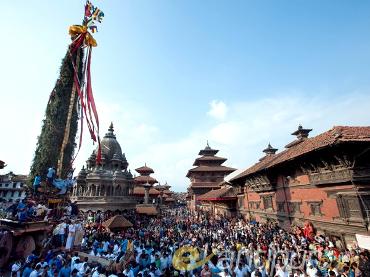 | About Newar CommunityThe different divisions of Newars had different historical developments before their arrival in theKathmandu valley. The common identity of Newar was only formed after their arrival in the valley. Until the unification ofNepal, with the possible exception of the Muslims under Gayasuddin who attacked and destroyed many parts of the valley, all people who had inhabited the valley at any point of time were either Newar or were progenitors of Newar. So, the history of Newar correlates to the history of Kathmandu valley prior to the unification ofNepal. The earliest known history of Newar and the Kathmandu valley were recorded in the form of mythical scriptures. One such text, which recounts the creation of the valley, is theSwayambhu According to the Swayambhu Purana, the Kathmandu valley was a giant lake called Nāgdaha until the Bodhisattva Manjushree, with the aid of a holy sword called Chandrahrāsa, cut open part of the southern hill of Kachchhapāla and then cut open Gokarnadaha and drained the giant lake, allowing humans to settle the valley land. This apocryphal legend is supported by some geological evidence of an ancient lakebed and it provides an explanation for the high fertility of Kathmandu valley soil. According to theSwayambhu Purana, Manjusri then established a city called Manjupattan (Sanskrit "Land Established by Manjusri"), now called Manjipā, where he crowned Dharmākara as the king of the land. A shrine dedicated to Manjusri is still present in Majipā. No recorded historical document has been found after this era till the advent of Gopal era. A genealogy of emperors is recorded in a book calledGopal Raj Banshawali. According to this manuscript, Gopals were followed by Mahispals, and Kirats before Licchavis entered from south. Some claim Buddha to have visited Nepal during the reign of Kirat emperor Jitedasti. TheLichhavidynasty ruled for at least 600 years, followed by theMalla dynastyin 12th century AD. TheNepal Bhasascript is estimated to be at least 1200 years old. Nepal Bhasa inscriptions in an ancient manuscript,Nidan, from 901 AD and on a stone tablet from 1173 AD in the courtyard of Bajrayogini Temple at Sankhu, attest to the deep roots of Newar culture in the Kathmandu valley. Newar reign over the valley and their sovereignty and influence over neighboring territories ended approximately 250 years ago with the conquest of the Kathmandu valley in 1769 by theGorkhali Shahdynasty founded byPrithvi Narayan Shah. Newars were engaged in business between Tibet and Moguls in India. So, to affect theMogul empire's treasury, theBritish East India Companysupplied weapons and advice to Prithvi Narayan Shah, who in return would conquer KathmanduValley and put an end to the trade between Tibet and Moguls of India. Systematic brutal suppression of the Newar people was pursued for generations during early dynastic rule in order to discourage the Newar people from any political aspiration. The Newar maintain a highly literate culture and their members are prominent in every sphere, fromagriculture,business,educationand government administrationtomedicine,law,religion,architecture,fine art, andliterature.There is a wide acceptance of the fact that Newar architects may have been responsible for developing Asia's hallmark multi-tieredpagodaarchitecture.Newar devotionalpauba and thanga painting, sculpture and metal craftsmanship are world-renowned for their exquisite beauty. The fine temples and palaces of Kathmandu, Patan (Yala) and Bhaktapur are largely the product of Newar architects, artisans and sculptors.Now the enterprising Newars are spread across Nepal, Bhutan, the state of Sikkim and the district of Darjeeling in India. |
Religion
Newar practice both Hinduism and Buddhism. According to the 2001 Nepal Census, 84.13% of Newars were Hindus and 15.31% were Buddhists.
Out of the three main cities of Kathmandu valley which are historically Newar, Patan is mostly Buddhist containing the four stupas built by Ashoka, Bhaktapur is primarily Hindu whereas Kathmandu is mixed.
